
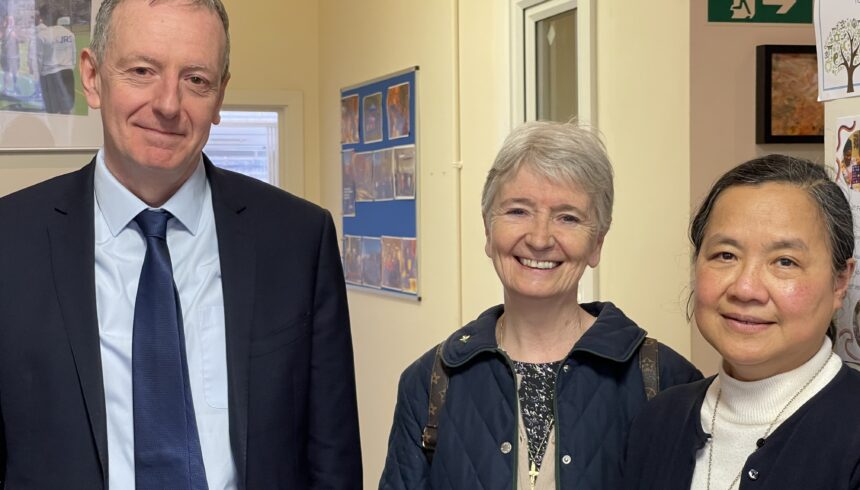
I have been volunteering with JRS UK for several years now, first as a social visitor to individuals who have been detained at Harmondsworth and Colnbrook IRCs, and more recently as part of the chaplaincy team. My social visits were always in a designated visiting space, but my visits now take me into the welfare areas, where people go to seek help.
I am often approached by people who don’t know who I am, hoping they can speak to someone from the Home Office or a legal representative! And though I cannot dispense legal advice, that encounter usually leads to the telling of their story, and we become friends.
I have come to appreciate the importance of listening deeply to each story: each person has a story which carries with it unbelievable pain and fear born out of terrible experiences. Many of the people say to me: “nobody listens”. Often there is nothing I can do but listen and sit with them; the people I speak with really appreciate it when they are heard. That they are seen and acknowledged as fellow human beings hopefully helps them to recognise their own inherent dignity, which is so obvious to anyone who pays attention, but which is too often denied.
Over the past months an unusually high number of children (aged between 16 and 18) have been detained in Harmondsworth and Colnbrook. Meeting these young people has been one of the moving aspects of my ministry. Despite being children, they are detained, sometimes for months, until their claimed age is accepted by Social Services and the Home Office. Some children are released into the care of Social Services, but others are declared adults and deported to France, where they are at risk of homelessness and exploitation.
Many people have shared stories of fleeing conflict, violence, and persecution. Many have shared with me accounts of leaving home because if they stayed, they would have been forced into service in the army or militia. Hearing stories like these often causes me to reflect on what it must be like to be forced to leave your home and family in search of safety, how difficult it is to find those very fundamental human needs, and how we are called to respond as Christians.
For most of the children who leave their homeland, the journey, which eventually brings them to Harmondsworth, where I meet them, is fraught with danger and some children have been badly damaged by their experiences. Some have been physically and sexually abused, and this can leave them fearful of strangers with whom they now share an enclosed space. Sometimes, because of deep trauma at home and during their journey, venturing beyond that room can be very challenging and so young people can miss out on the limited facilities and help available in the centre.
Some of the children I meet do not speak English. As well as being in a very strange place they are further isolated by being unable to express their needs to staff on their wing, in healthcare, at mealtimes, and in other situations. This can cause some of them to withdraw. However, I find there’s never a problem finding a person to translate for me: someone always materialises to translate as soon as they see me with a young person. The kindness I see people offer to each other and to myself never fails to touch me.
Some people have asked me, ‘How can our country sustain taking in so many people?’ As Christians, our response cannot begin with calculations but instead with the recognition of human dignity. It demands faith, compassion, kindness, welcoming, inclusion, and, very importantly, generosity. These values can only be expressed when we are willing to put ourselves in community with others.
Our faith is in a God who cares deeply for those who are vulnerable and who appreciates it beyond measure when we take care of them. We have heard it said, ‘God is never outdone in generosity’. If we are generous as a society, our generosity will be repaid again and again. Welcoming the stranger in need with a generous heart means that our society will be richer, not poorer, for their presence among us.
