
Two small coins and a generous heart
Every year on 5th September, International Day of Charity invites us to think about generosity and the many ways in which we can support one another. The story of the widow and her two small coins, found in the Gospel of Mark, gives us a moment to pause over the word charity itself, and to look more closely at what it asks of us.
Charity is often understood as giving something to someone in need. goes further: it is a theological virtue rooted in love of God and love of our neighbour. The Catechism places this love alongside dignity, the rights of others, and the call to justice, reminding us that charity is not separate from the way we see and respond to one another.
Pedro Arrupe SJ, founder of the Jesuit Refugee Service, spoke of our call “to give ourselves to others in love”. His words bring this expanded understanding of charity into relationship: to love another person is first to recognise their dignity, and to encounter them as someone with gifts of their own to share.
But what makes a gift truly generous?
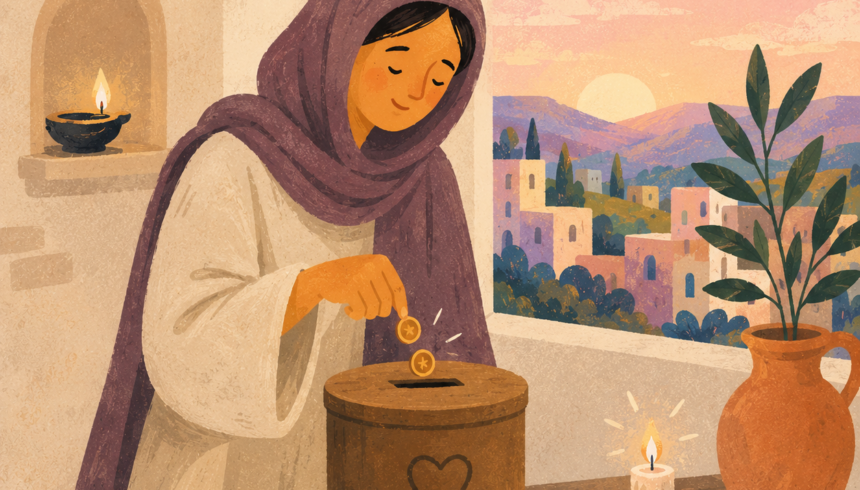
In the Gospel of Mark, Jesus sits opposite the temple treasury, watching as people come forward to make their offerings. Many wealthy people give large amounts, until a poor widow approaches and quietly puts in just two small coins. Jesus says:
“Truly, I say to you, this poor widow has put in more than all those who are contributing to the offering box. For they all contributed out of their abundance, but she out of her poverty has put in everything she had, all she had to live on.” – Mark 12:43–44
He invites his disciples to look beyond the two coins and to notice something that numbers could never reveal: the love, trust, and self-giving with which she gives.
Reflecting on this passage, Pope Francis reminds us that “God does not measure quantity but quality; he examines the heart.”
A donation, our time, a skill shared with others, a prayer, a voice raised or simply our presence can all be different expressions of the same love. Perhaps the invitation at the heart of the widow’s story is to look not only at what is given, but at the love we bring to the act of giving.
When giving becomes encounter
Arrupe’s call ‘to give ourselves to others in love’ takes on a particular meaning in the way JRS understands accompaniment. Love invites us to encounter one another through the dignity we share: to listen, to get to know the person in front of us, and to discover in them far more than what they may need.
A hot meal, clothing, financial assistance or a safe and welcoming place can make a real difference in moments marked by uncertainty and isolation.
But around that practical support, other things happen too: someone is welcomed by name, a cup of tea becomes a conversation, and a meal becomes a shared table. These are simple moments, but they are moments in which support can become encounter, and encounter can grow into relationship and community.
And that community is built and transformed by everyone. We see this in so many ways: refugee friends sharing a recipe or a skill, tending the garden, leading prayer and creative activities, supporting someone going through a difficult time. When we make space to truly know one another, we discover that accompaniment is never one-sided. Refugee friends do not simply receive support (having been made to be reliant on it by hostile policies) – they shape our community through their friendship, resilience, generosity, and care for others.
To accompany one another is to meet through the dignity we share and to allow that encounter to transform us all. In this sense, charity is never a one-way act of giving, but a relationship in which each person has gifts to offer and lessons to teach.
“Little children, let us not love in word or talk but indeed and in truth.” – 1 John 3:18
For Arrupe, love and justice could not be separated. This is why accompanying, serving, and advocating belong to the same mission: walking alongside our refugee friends, responding to the realities they face, and working with them towards a society in which every person is recognised in the fullness of their dignity.
This International Day of Charity, we celebrate these many expressions of love and the relationships they make possible. The widow leaves us with a simple invitation: to look beyond what can be counted, recognising that each of us has something to give and, in encountering one another, something to receive.
With every blessing this International Day of Charity,
